- Horizon AI
- Posts
- Use this Claude trick to turn boring slideshows into magazine-style summaries 📰
Use this Claude trick to turn boring slideshows into magazine-style summaries 📰
A beanie designed to read your thoughts 🤯

Gina Acosta
April 17, 2026
In partnership with


Welcome to another edition of Horizon AI,
When you tell Claude to "make a slideshow" to summarize a large amount of information, the results are often visually disappointing. In today's issue, we show you a simple trick that makes Claude's summaries look a whole lot better.
Let’s jump into it!
Read Time: 4.5 min
Here's what's new today in the Horizon AI
Anthropic Releases Claude Opus 4.7
OpenAI Upgrades Codex with Computer Use, Image Generation Capabilities
AI Tutorial: How to generate magazine-style summaries with Claude
AI Tools to check out
AI Findings/Resources
The Latest in AI and Tech 💡
AI News
ANTHROPIC
Anthropic Releases Claude Opus 4.7

Anthropic has launched Claude Opus 4.7, its most powerful publicly available model yet, reclaiming a slight edge over rivals in an increasingly tight competition.
Details:
Claude Opus 4.7 outperforms competing models like GPT-5.4 and Gemini 3.1 Pro on several key benchmarks, particularly in agentic coding, tool use, computer use, and financial analysis, though it still trails in areas like agentic search and raw terminal-based coding.
The model comes with improved multimodal capabilities, allowing it to better interpret detailed visuals and complex interfaces.
Anthropic has also introduced new controls like an “effort” parameter, letting users balance reasoning depth with cost and speed, alongside tools to manage token usage.
Opus 4.7 is available across all Claude products, the API, Amazon Bedrock, Google Cloud's Vertex AI, and Microsoft Foundry, at the same price as Opus 4.6.
Despite what the benchmarks show, some users are reporting that the new model is actually a downgrade from 4.6, citing issues like ignored instructions and overall reduced reliability.
TOGETHER WITH NEO
AI help, without the trust tax.
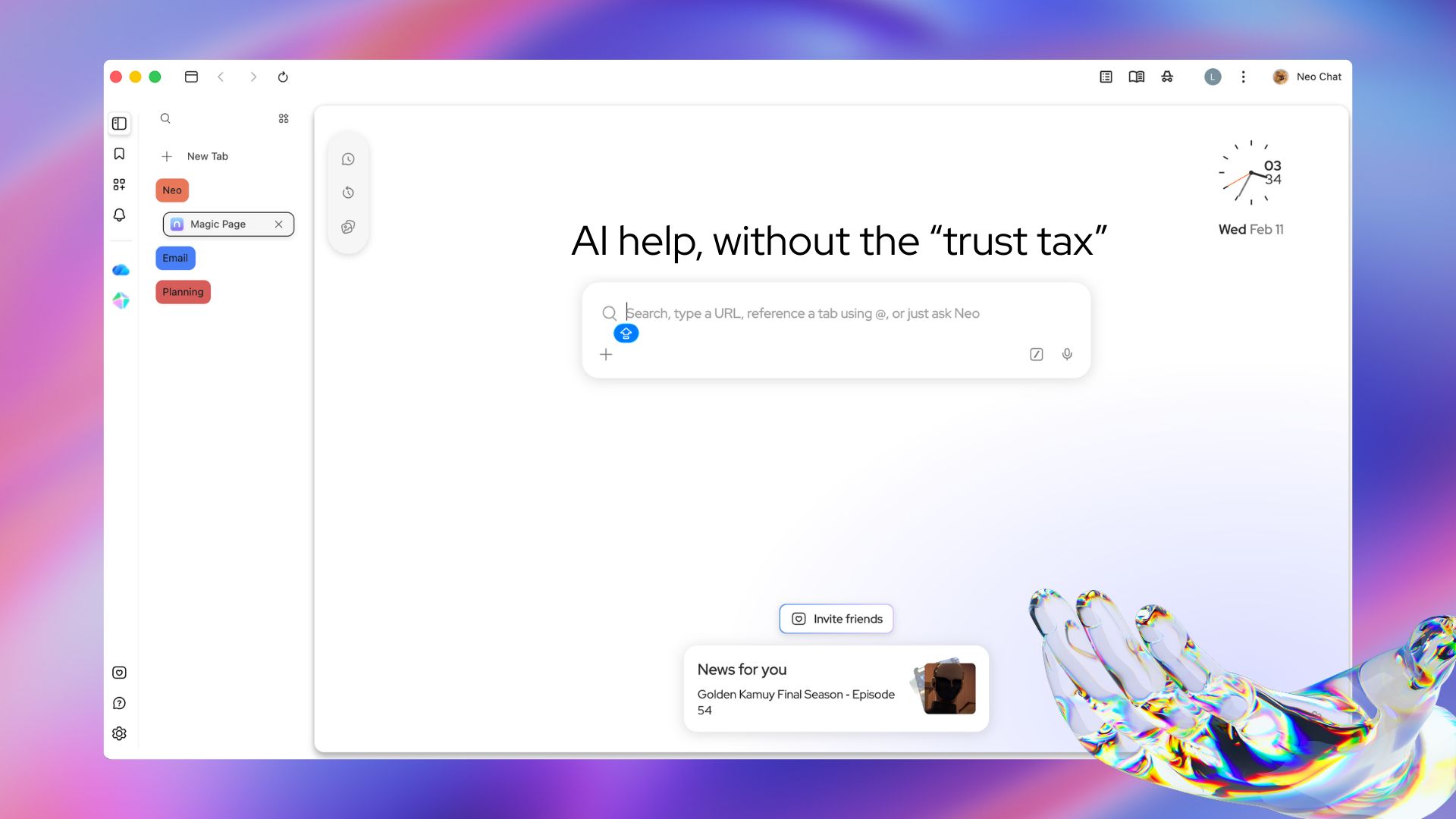
Most AI tools ask you to trade your data for intelligence. Norton Neo doesn't. It's the first safe AI-native browser built by Norton, and it gives you powerful built-in AI without handing your privacy over to get it. Search, summarize, and write with AI built directly into your browser. Your data stays yours. Your context stays private.
Built-in VPN, anti-fingerprinting, and ad blocking come standard. No add-ons. No setup. No compromises.
Fast. Safe. Intelligent. That's Neo.
OPENAI
OpenAI Upgrades Codex with Computer Use, Image Generation Capabilities

OpenAI has rolled out a major update to Codex, expanding its capabilities with deeper automation, personalization, and the ability to operate in the background on your computer.
Details:
Codex can now operate desktop apps on your computer, working in the background without interrupting your workflow, while multiple agents can run tasks in parallel.
The feature is rolling out first to macOS users, with broader platform support and EU availability expected at a later stage.
The system now supports image generation and iteration using gpt-image-1.5, alongside new integrations with tools like GitLab, Atlassian Rovo, and Microsoft Suite.
Codex also adds native web browsing through an in-app browser, allowing users to comment directly on pages to provide precise instructions to the agent.
New automation features let Codex reuse past conversations, schedule future tasks, and resume long-running work automatically, making it more autonomous over time.
A new memory system enables Codex to retain preferences, corrections, and useful context from previous interactions.
These updates come as OpenAI pushes to compete more aggressively in AI-powered coding, especially against rivals like Anthropic and Google.
AI Tutorial
How to generate magazine-style summaries with Claude

Go to Claude.ai and sign in.
Use this prompt:
Create a 10-page horizontal-swipe editorial magazine as a single HTML file.

My brand: [PRODUCT NAME], [URL], primary color [HEX/HSL], heading font [GOOGLE FONT], body font [GOOGLE FONT]
Pages: Cover, Problem, Solution (steps), Features, Audience, Competition, Origin Story, Launch/Traction, Tech, Back Cover
About my product: [PASTE WHATEVER YOU HAVE: pitch deck text, landing page copy, about page, notes, bullet points. The more the better but anything works.]
Design rules (non-negotiable):

100vw x 100vh pages, horizontal scroll-snap, no vertical scrolling
Full-bleed edge-to-edge layouts only. No padded cards floating on backgrounds
Split layouts (left/right color blocking), viewport-filling grids, 2x2 quadrants
Key stats rendered at 100px+ font size as visual anchors
Dark panels on 3+ pages for contrast. Cover and back cover are dark
Each page a different background tint. Nav dots at bottom. Arrow key support
Credit: jasondoesstuff on X
AI Tools to check out
🔥 Skywork: Turn simple input into multimodal content - docs, slides, sheets, webpages and videos (with Seedance 2.0).
✅ Intent: A developer workspace where agents are coordinated, specs stay alive, and every workspace is isolated.
🎭 Flyne: Free advanced AI image & video generator.
⚡ Fastlane: AI short-form content engine, where you can remix viral videos into content for your business in seconds.
🖥 Scalify: The world's first platform that enables businesses to order professional websites and digital marketing services in minutes.
TOGETHER WITH FISHER NEO
Stop switching apps. Your browser can do it all.

Every tab you open, every copy-paste into ChatGPT, every lost train of thought — that's your browser failing you. Norton Neo fixes it. Built-in AI works directly inside your session. Hover to preview. Search everything from one bar. VPN and ad blocking included, free.
AI Findings/Resources
🔍 One prompt, three models: Opus 4.7 vs. Gemini 3.1 Pro vs. GPT-5.4
💼 From layoffs to leverage: How AI is turning workers into entrepreneurs
🔨 A 16-min tutorial on how to use Gemini 3.1 + Seedance 2.0 to build cinematic $10k websites
The latest in AI and Tech

Silicon Valley startup Sabi is developing a wearable brain-computer interface that decodes a person’s internal speech into words on a computer screen. The device uses high-density EEG sensors and AI models to decode neural activity, with an initial target of about 30 words per minute.
Unlike implanted systems such as Neuralink, Sabi is pursuing a noninvasive approach aimed at broader consumer use.
The reasoning model was built to support research tasks in biology, chemistry, and drug discovery. It is designed for evidence synthesis, hypothesis generation, experiment planning, and data analysis, and is said to outperform earlier GPT models in several scientific benchmarks.
For now, GPT-Rosalind is available only as a research preview for qualified U.S. enterprise users.
Kering CEO Luca de Meo has confirmed a new partnership with Google to launch Gucci-branded smart glasses sometime in 2027. Meanwhile, Google's first pair of Android XR glasses, "Project Aura," are expected to launch this year.
Novartis' Chief Executive Officer Vas Narasimhan is the first pharmaceutical executive to join the company’s governing body. The appointment signals deeper ties between AI and healthcare as interest grows in applying advanced models to scientific and medical research.
The company is adding new features to AI Mode that let users browse web pages alongside AI-powered search and bring open tabs into their queries. The update is designed to make it easier to compare information, ask follow-up questions, and keep context while researching.
That’s a wrap!
We'd love to hear your thoughts on today's email!Your feedback helps us improve our content |
Not subscribed yet? Sign up here and send it to a colleague or friend!
See you in our next edition!
Gina 👩🏻💻