- Horizon AI
- Posts
- Is your AI code reviewer actually any good? Here's how to find out 👇
Is your AI code reviewer actually any good? Here's how to find out 👇
US AI Giant Accuses Chinese Rivals of Mass Data Theft 😱

Gina Acosta
February 24, 2026
In partnership with


Welcome to another edition of Horizon AI,
Your team picked an AI code reviewer. Cool. But do you actually know if it's catching what it should? In today's issue, we show you how you can benchmark your own tool against 8 others to see just how good it actually is.
Let’s jump into it!
Read Time: 4.5 min
Here's what's new today in the Horizon AI
Anthropic Accuses Chinese Rivals of 'Distillation Attacks' on Its Models
How AI Is Improving Post-Mortem Time of Death Accuracy
AI Tutorial: How to check if your AI code reviewer is actually good
AI Tools to check out
AI Findings/Resources
The Latest in AI and Tech 💡
AI News
ANTHROPIC
Anthropic Accuses Chinese Rivals of 'Distillation Attacks' on Its Models
Anthropic claims several Chinese AI firms created tens of thousands of fake accounts to extract knowledge from its Claude model, escalating tensions in the global AI race.
Details:
Anthropic says DeepSeek, Moonshot AI, and MiniMax set up more than 24,000 accounts that generated over 16 million exchanges with Claude, a technique known as "distillation."
Distillation is a common training method AI labs use on their own models to create smaller, cheaper versions, but competitors can use it to essentially copy the work of other labs.
Anthropic claims the labs generated large volumes of carefully crafted prompts designed to extract specific capabilities from the Claude model, targeting mostly agentic reasoning, tool use, and coding.
The scale varied by company, with Moonshot linked to more than 3.4 million exchanges and MiniMax to about 13 million focused on coding and orchestration.
Anthropic says it is investing in defenses to identify and prevent distillation attacks and is also calling for "a coordinated response across the AI industry, cloud providers, and policymakers," warning that models built via illicit distillation may lack key safety protections.
TOGETHER WITH ENERGYX
Meet America’s Newest $1B Unicorn

A US startup just hit a $1 billion private valuation, joining billion-dollar private companies like SpaceX, OpenAI, and ByteDance. Unlike those other unicorns, you can invest.
Over 40,000 people already have. So have industry giants like General Motors and POSCO.
Why all the interest? EnergyX’s patented tech can recover up to 3X more lithium than traditional methods. That's a big deal, as demand for lithium is expected to 5X current production levels by 2040. Today, they’re moving toward commercial production, tapping into 100,000+ acres of lithium deposits in Chile, a potential $1.1B annual revenue opportunity at projected market prices.
Right now, you can invest at this pivotal growth stage for $11/share. But only through February 26. Become an early-stage EnergyX shareholder before the deadline.
This is a paid advertisement for EnergyX Regulation A offering. Please read the offering circular at invest.energyx.com. Under Regulation A, a company may change its share price by up to 20% without requalifying the offering with the Securities and Exchange Commission.
AI RESEARCH
How AI Is Improving Post-Mortem Time of Death Accuracy

Researchers in Sweden have developed an AI method that can estimate time of death more accurately by analyzing the metabolites in blood samples collected at autopsy.
Details:
Scientists from Linköping University and the Swedish National Board of Forensic Medicine trained an AI model on metabolites found in thousands of post-mortem blood samples.
When the body dies, metabolites in the blood break down in a predictable way that correlates with how much time has elapsed since death. This allows the model to assess the actual time of death of an individual.
Current forensic methods such as body temperature, rigor mortis, and eye potassium become less reliable after several days, which is where the AI approach shows an advantage.
The team built a unique dataset from more than 45,000 autopsies collected over nearly a decade, using 4,876 cases with known timelines to train the model.
In testing, the system estimated time since death with a precision of about one day, even for those deceased for up to 13 days, a clear improvement over many existing techniques.
The researchers say they will keep working on developing even more accurate models, potentially narrowing estimates to specific parts of the day. This could become a valuable new tool for forensic investigations, especially in complex cases where traditional methods struggle.
AI Tutorial
How to check if your AI code reviewer is actually good

Go to the Entelligence Code Review Benchmark 2026. They benchmarked 8 tools on actual pull requests and published the full methodology. You can check the results there.
The report includes a live comparison tool where you can benchmark your own code review bot. Just scroll down and select "Try on your repo."

Sign up, set up code review, and select 'Bot Comparison' to see how your tool stacks up against the others.
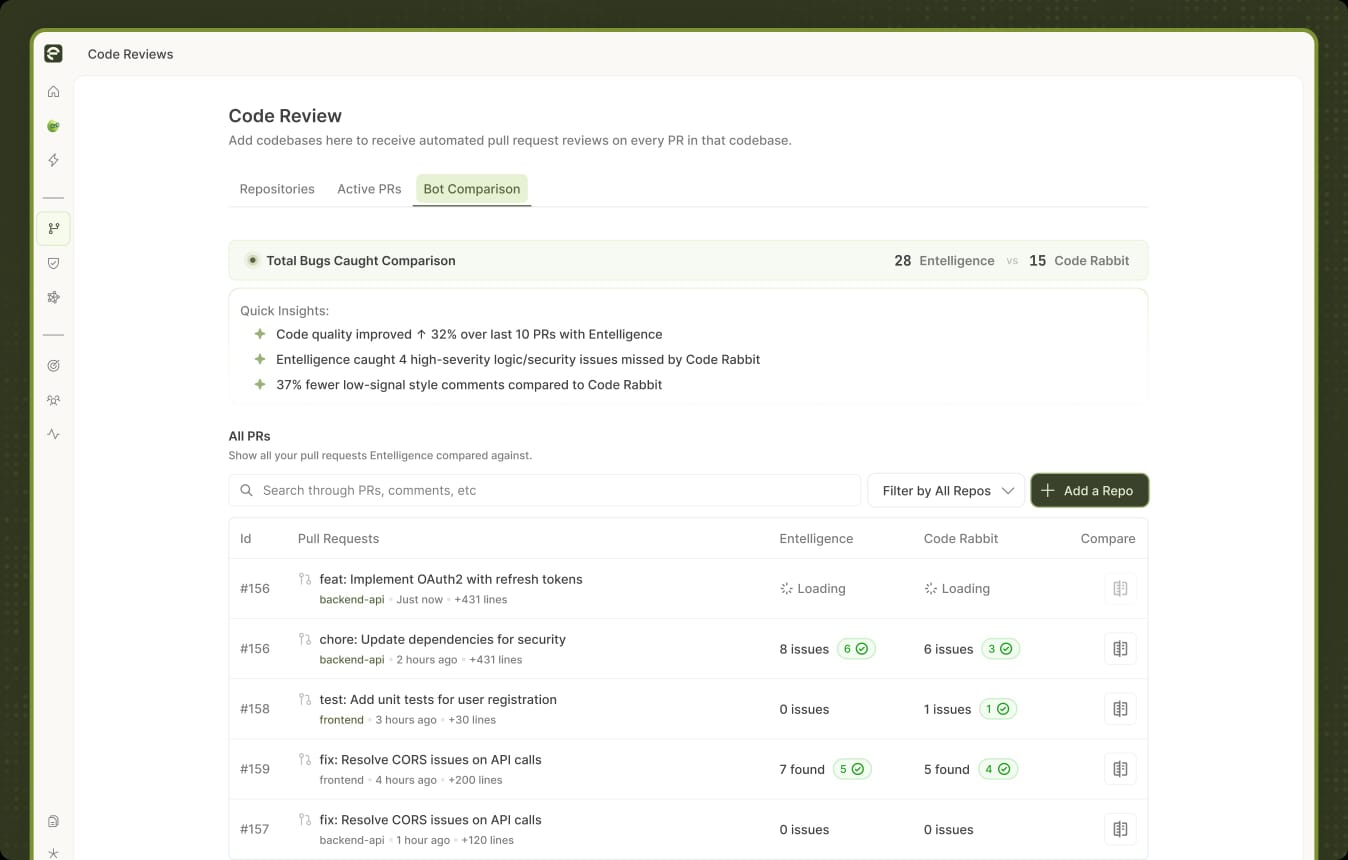
The gap between some of these tools compared to others was huge. If you're responsible for any kind of tooling decisions, this one is definitely worth a look.
AI Tools to check out
🔍 Lucid Engine: See if ChatGPT, Perplexity and Google AI recommend your brand — and get a step-by-step plan to fix it.
👨💻 Imagine.dev: AI-coding tool that builds real apps with the backend included.
🔴 Red: A seamless AI companion that integrates perfectly into your workflow.
🎶 Anymelo: Compose tracks and create royalty-free music effortlessly
✨ Img2.AI: Turn any image into AI art & video.
TOGETHER WITH WISPR FLOW
You think 4x faster than you type. Why slow down?

Wispr Flow turns your voice into ready-to-send text inside any app. Speak naturally and Flow handles the cleanup -- stripping filler words, fixing grammar, formatting everything properly.
For developers, this means:
Dictate into Cursor, VS Code, or any IDE with full syntax accuracy
Give coding agents 10x more context by talking instead of typing
Write PRs, docs, and Linear tickets without switching to a text editor
Respond to Slack and email without breaking your flow state
Used by teams at OpenAI, Vercel, and Clay. 89% of messages sent with zero edits. Millions of users worldwide.
Available on Mac, Windows, iPhone, and now Android - free and unlimited on Android during launch.
AI Findings/Resources
😱 OpenClaw nearly wipes out AI researcher’s inbox without permission
🦅 Here are the 17 US-based AI companies that have raised $100M or more in 2026
The latest in AI and Tech
The feature allows users to create custom playlists by simply describing what they want to listen to.
Initially only available in New Zealand, it recently expanded to the US and Canada. Now the company has announced it is rolling out the tool to Premium subscribers in the UK, Ireland, Australia, and Sweden.
OpenAI is expanding its enterprise strategy by forming multi year partnerships with four major consulting firms: Boston Consulting Group, McKinsey & Company, Accenture, and Capgemini.
Through the program, OpenAI’s Forward Deployed Engineering team will work alongside these firms to implement OpenAI’s enterprise-focused technologies into customers’ tech stacks.
xAI has signed an agreement with the U.S. Department of Defense to allow its Grok model to operate inside classified military systems, marking a major expansion of the startup’s government footprint. The move gives the Pentagon another frontier AI option for sensitive work such as intelligence analysis, weapons development, and battlefield planning.
Canva announced it is acquiring two startups to expand its creative and marketing capabilities.
The company is buying Cavalry, a U.K. based 2D motion animation platform, and MangoAI, which focuses on improving video ad performance using reinforcement learning.
An analyst group, Citrini Research, has published a scenario outlining how rapid adoption of agentic AI could trigger major economic disruption within two years.
The hypothetical future describes unemployment doubling and stock market value falling by more than a third, driven by a feedback loop in which improving AI reduces the need for white collar workers, cuts consumer spending, and pushes companies to invest even more aggressively in automation.
That’s a wrap!
We'd love to hear your thoughts on today's email!Your feedback helps us improve our content |
Not subscribed yet? Sign up here and send it to a colleague or friend!
See you in our next edition!
Gina 👩🏻💻