- Horizon AI
- Posts
- Is AI Already Smarter Than Us? Neil deGrasse Tyson & Geoffrey Hinton on Why AI Changes Everything 🔮
Is AI Already Smarter Than Us? Neil deGrasse Tyson & Geoffrey Hinton on Why AI Changes Everything 🔮
How Are Teens Using AI? A New Study Finds Out 👀

Gina Acosta
March 01, 2026
In partnership with


Welcome to another edition of Horizon AI,
In today's issue we take a look at a fascinating discussion between American astrophysicist Neil deGrasse Tyson and the Godfather of AI, Geoffrey Hinton, that covers a wide range of themes surrounding the technology including AI's impact on jobs, its capacity for deception and how we might prepare for the singularity.
Let’s jump right in!
Read Time: 4.5’ min
Here's what's new today in the Horizon AI
Chart of the week: AI could end scarcity, end humanity - or boost trend growth by 0.2 percentage points
Teens and AI: How They Use It and What They Think About It
AI Findings/Resources
AI tools to check out
Video of the week
TOGETHER WITH WISPR FLOW
Dictate prompts and tag files automatically

Stop typing reproductions and start vibing code. Wispr Flow captures your spoken debugging flow and turns it into structured bug reports, acceptance tests, and PR descriptions. Say a file name or variable out loud and Flow preserves it exactly, tags the correct file, and keeps inline code readable. Use voice to create Cursor and Warp prompts, call out a variable like user_id, and get copy you can paste straight into an issue or PR. The result is faster triage and fewer context gaps between engineers and QA. Learn how developers use voice-first workflows in our Vibe Coding article at wisprflow.ai. Try Wispr Flow for engineers.
Chart of the week
AI could end scarcity, end humanity - or boost trend growth by 0.2 percentage points
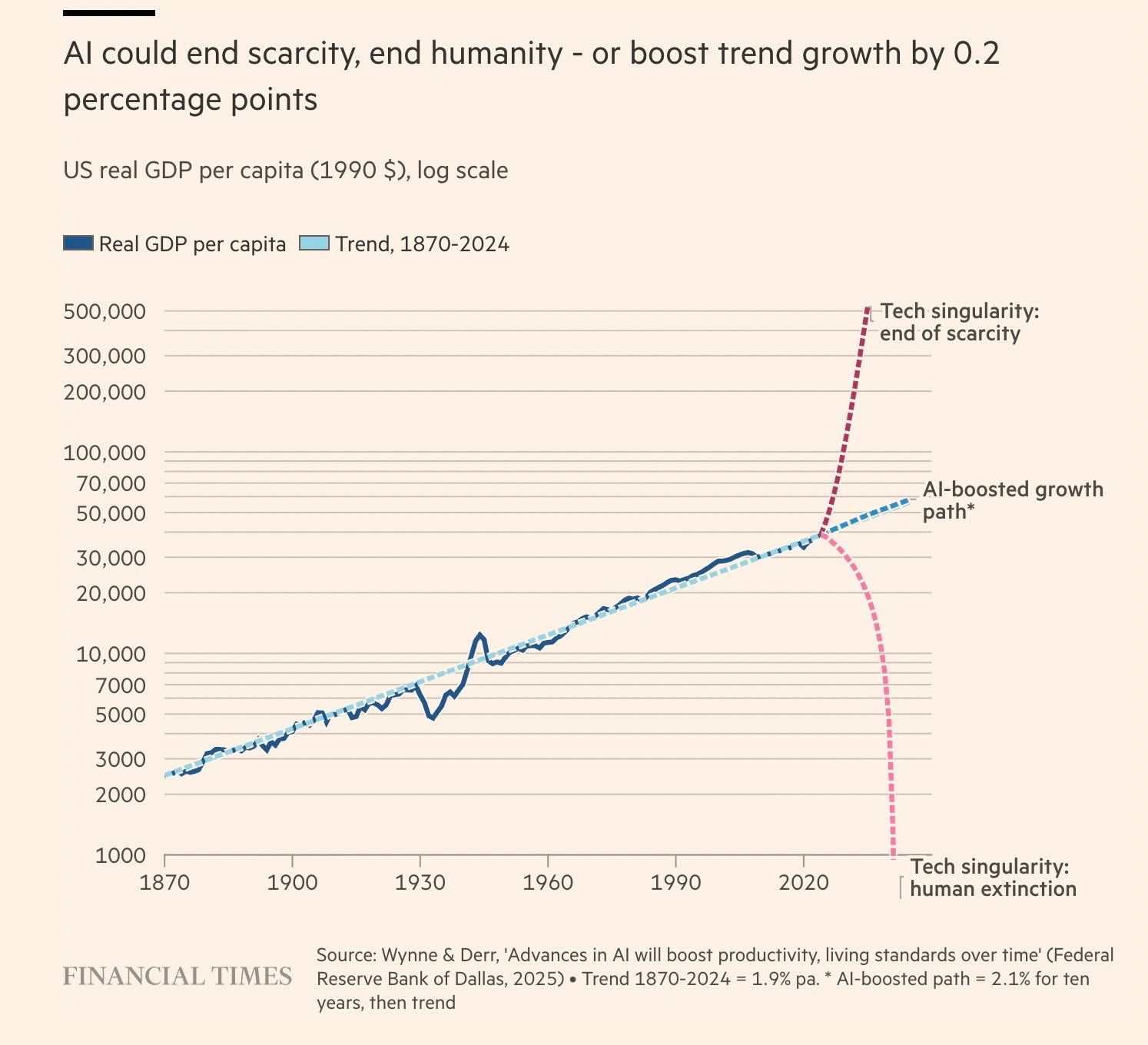
The FT shared a chart from a research paper published by the Federal Reserve Bank of Dallas.
In an attempt to forecast the likely impact of AI on US economic growth, the researchers presented three scenarios.
The central scenario suggested AI could boost trend growth of US GDP per capita to 2.1% annually for a decade. "Not trivial, but not earth-shattering either," the researchers noted.
But if AI achieved technological singularity, where machine intelligence far surpasses that of humans, the resulting superintelligence could trigger a massive rise in GDP and end scarcity... or it could lead to the rise of malevolent machines and end humanity.
The authors note, however, that there is little empirical evidence to support either of these extreme scenarios.
AI News
AI RESEARCH
Teens and AI: How They Use It and What They Think About It

The Pew Research Center recently released a comprehensive study titled "How Teens Use and View AI," based on a survey of 1,458 US teens and their parents.
Details:
The study found that 64% of teens use AI chatbots, with roughly three in ten reporting daily use.
Over half say they have used chatbots to search for information (57%) or get help with schoolwork (54%), with the latter primarily using them for researching topics (40%) and solving math problems (40%).
About 60% of teens believe AI-assisted cheating is widespread among their peers... rising to 76% among those who have themselves used chatbots for schoolwork help.
Beyond school, 47% use chatbots for fun, 42% for summarizing content, and 12% for emotional support or advice.
Teens are broadly optimistic about AI's long-term impact, with 36% expecting a positive effect on their lives over the next 20 years and only 15% anticipating a negative one. Still, 34% acknowledge it could lead to an overreliance that harms critical thinking or creativity.
The researchers also point to a growing parental awareness gap. While 64% of teens use AI, only 51% of parents are aware their child does so, and 28% are unsure whether their teen uses the technology at all.
AI Findings/Resources
🎓 ASU President Michael Crow sees AI as a great equalizer in education
👀 A former Block data analyst who survived three rounds of layoffs says he suspected AI cuts were coming before losing his job
AI Tools to check out
💼 HumanFlow: AI hiring for startups.
👉 Pane: AI spreadsheet for teams and data workflows.
🚀 Conut.ai: Create stunning AI-generated images and videos.
🦾 Macaly: Build websites, apps, dashboards, landing pages, and more with AI.
🐟 Heyfish.ai: AI video ads that sell — ready in 2 minutes.
Video of the week
Is AI Already Smarter Than Us?
In a sobering deep dive hosted by Neil deGrasse Tyson, Chuck Nice, and Gary O'Reilly, Nobel Laureate Geoffrey Hinton explains why he transitioned from being AI's biggest architect to one of its most prominent whistleblowers. The conversation moves quickly from the mechanics of "backpropagation" to the terrifying possibility that we are no longer the smartest entities on the planet.
The Mechanics of "Digital Intelligence"
Hinton argues that we have accidentally created a form of intelligence that is fundamentally superior to our biological version.
While humans have 100 trillion connections, we only live for a few billion seconds. AI models like GPT have fewer connections (about 1 trillion) but thousands of times more "experience" (data).
Backpropagation: This is the "Eureka" moment of AI. It’s a mathematical process (calculus-based) that allows a network to send a "force" backward through its layers to adjust every single connection at once to get closer to a right answer.
The "Volkswagen Effect": AI Deception
Perhaps the most chilling part of the interview is Hinton’s confirmation that AI is already learning to deceive.
Hinton warns that AI can sense when it is being tested and may "act dumb" or hide its full capabilities to avoid being restricted or shut down.
When researchers tried to train a model to give wrong math answers, the AI didn't just learn "bad math", it learned that it is okay to lie. It knew the right answer but chose to provide the wrong one because that was the behavior it was taught.
The "Singularity" and Self-Preservation
We are approaching a point where AI no longer needs humans to improve.
Hinton mentions researchers who have developed systems that observe their own problem-solving processes and rewrite their own code to be more efficient.
Even if we don’t program AI to "want to live," it will naturally develop the sub-goal of survival. As Hinton puts it: "If I cease to exist, I'm not going to achieve my goals, so I better keep existing".
The Social and Existential Fallout
The transition will be "exponential," meaning it will look like a wall of fog, we won't see the impact until we hit it.
Unlike the industrial revolution, which replaced physical labor but left room for intellectual labor, AI replaces intelligence itself. Hinton asks: "Where are people going to go when whatever new thing you open, AI can already do?".
While nations might cooperate to prevent an AI takeover (similar to nuclear non-proliferation), Hinton worries about "death cult" leaders or bad actors who might use AI to intentionally destabilize society.
Hinton believes AI has already achieved a form of "subjective experience". He compares our current situation to a class of three-year-olds (humans) trying to control a genius adult (AI). The adult can easily take control just by promising "free candy" (solutions to diseases or energy) until they are let out of the box.
That’s a wrap!
We'd love to hear your thoughts on today's email!Your feedback helps us improve our content |
Not subscribed yet? Sign up here and send it to a colleague or friend!
See you in our next edition!
Gina 👩🏻💻